Your Guide to Dietary Fat
UPDATED SEPTEMBER 2026
Fat has had a bit of an image problem.
For years, women were encouraged to choose everything low-fat. Then the message seemed to completely flip and suddenly avocado, nuts and coconut oil were everywhere, accompanied by claims that "healthy fats don't make you fat".
So which is it? Should we be eating less fat – or more of it? And which fats are actually healthy?
As is so often the case with nutrition, the answer isn't at either extreme.
We need fat in our diets, but the type of fat, how much we eat and what the rest of our diet looks like all matter.
In this article, I'll cut through some of the confusion around dietary fat and look at what the evidence actually tells us – and what that means when you're standing in the supermarket trying to decide between butter, olive oil and the latest "healthy" spread.
In This Article:
- Why Do Women need healthy fats?
- Which Fats Are Healthy?
- Healthy Fats Aren't Unlimited!
- Which Healthy Oil to Use?
- Omega 3 - A heathy Fat worth knowing about
- What about Saturated Fats?
- Butter V Margerine
- Is Coconut Oil A Healthy Fat?
- Do Healthy Fats Make You Gain Weight?
- What About Transfats?
- Healthy Fats For Women: What Does It Actually Look like?
Why Do Women Need Healthy Fats?
Fat isn’t something your body would rather do without.
We need it.
Dietary fat provides energy, supplies essential fatty acids and helps us absorb the fat-soluble vitamins A, D, E and K. Fatty acids are also important components of our cell membranes and are involved in many processes throughout the body.
And yes, fat is also relevant to hormones.
Our bodies use cholesterol as a building block for steroid hormones, including oestrogen and progesterone. But this doesn’t mean eating lots of dietary fat will “balance your hormones” – that’s an oversimplification I see far too often online.
When we talk about healthy fats for women, I’m much more interested in the bigger picture: heart health, cholesterol, metabolic health and getting enough essential fatty acids.
This becomes particularly relevant as we move through our 40s, 50s and beyond.
During perimenopause and menopause, falling oestrogen levels are associated with changes in cholesterol, blood pressure, insulin sensitivity and where we tend to store body fat. Cardiovascular health therefore becomes increasingly important.
Choosing the right fats is one practical way we can support our long-term health.
Which Fats Are Healthy?
This is where things can become unnecessarily complicated.
Most foods don’t contain just one type of fat. They contain a mixture of fatty acids in different proportions.
But broadly speaking, dietary fats can be divided into unsaturated fats, saturated fats and trans fats.
When nutritionists talk about healthy fats, we’re generally talking about foods that are predominantly rich in monounsaturated and polyunsaturated fats.
Good sources include:
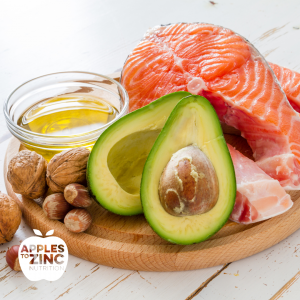
- Extra-virgin olive oil
- Rapeseed oil
- Nuts and seeds
- Avocado
- Nut butters
- Oily fish such as salmon, sardines and mackerel
These are the fats I want women to include fairly regularly.
One of the clearest findings from nutrition research is that replacing some saturated fat with unsaturated fat can help lower LDL and non-HDL cholesterol and support cardiovascular health.
That’s an important distinction.
The message isn’t:
“Eat less fat.”
It’s much closer to:
“Be smarter about the fats you choose.”
A Mediterranean-style diet is a great example. It certainly isn’t a low-fat diet. Olive oil, nuts, seeds and fish all feature regularly, yet this dietary pattern has some of the strongest evidence for supporting cardiovascular health.
Rather than thinking of these as “good” and “bad”, I prefer to think about which fats we want to prioritise and which we might want to eat a little less often.
Healthy Fats AREN'T Unlimited!
This is one of those nutrition messages that can easily get lost.
- Olive oil is nutritious.
- Nuts are nutritious.
- Seeds are nutritious.
- Avocado is nutritious.
But healthy fats are still energy dense.
Fat provides around 9 calories per gram, compared with around 4 calories per gram from protein and carbohydrate.
That doesn’t mean you need to start meticulously weighing your olive oil or counting every almond.
But I wouldn’t recommend free-pouring oil over everything either.
It’s surprisingly easy to pour two or three tablespoons into a frying pan or over a salad without noticing. A tablespoon of oil provides roughly 100–120 calories, so those generous glugs can add up quite quickly.
Use a teaspoon, measuring spoon or controlled drizzle instead.
This is a perfect example of something I talk about frequently with clients:
Healthy doesn’t mean unlimited.
We can include plenty of nutritious foods while still being aware of portions.
Which Healthy Oil To Use?
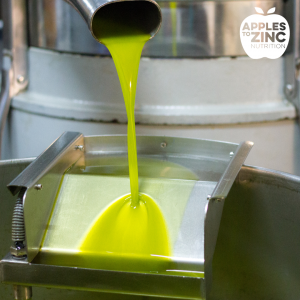
For everyday use, I generally favour olive oil and rapeseed oil because they’re predominantly unsaturated.
And where practical, I particularly like extra-virgin or cold-pressed olive oil.
Extra-virgin olive oil is mechanically extracted rather than being heavily refined and retains more of the naturally occurring plant compounds, including polyphenols, found in olives.
These compounds are one of the reasons extra-virgin olive oil is of such interest within Mediterranean-style eating patterns.
It’s fantastic for salad dressings, drizzling over vegetables and adding to meals after cooking.
And despite a persistent internet myth, you can cook with olive oil too. It doesn’t suddenly become “toxic” when you heat it during normal home cooking.
Cold-pressed rapeseed oil is another useful option. It’s predominantly unsaturated and relatively low in saturated fat.
You don’t need six different bottles of oil in your cupboard.
For most households, a good-quality olive oil and perhaps a cold pressed rapeseed oil will cover most everyday needs.
And remember – whichever healthy oil you choose, you still don’t need to free-pour it!
Omega 3: A Healthy Fat Worth Knowing About
Omega-3 fats deserve a special mention because some types are essential – our bodies can’t make them from scratch, so we need to obtain them through our diet.
Oily fish is particularly useful because it provides the long-chain omega-3 fats EPA and DHA.
UK guidance recommends eating at least two portions of fish each week, including one portion of oily fish.
A good acronym to remember the oily fish is SMASHT (sardines, mackerel, anchovies, salmon, herring and trout)
Plant foods such as walnuts, chia seeds and flaxseeds also contain omega-3, predominantly in the form of ALA.
Our bodies can convert some ALA into EPA and DHA, but the conversion is relatively limited, which is why oily fish is particularly useful. if you can eat it.
You may also have read that you need to achieve a precise ratio between omega-3 and omega-6 fats.......I wouldn’t worry about calculating it. For most women, that’s another nutrition rule you simply don’t need taking up valuable headspace.
Focus instead on regularly eating oily fish, nuts and seeds and choosing predominantly unsaturated oils.
What About Saturated Fats?
This is where social media can make nutrition unnecessarily confusing.
You’ll find people telling you saturated fat is terrible.
And others telling you we’ve been lied to about it and you can eat as much butter, cheese and coconut oil as you like.
Neither extreme is particularly helpful.
Current UK recommendations advise the average woman to consume no more than around 20g of saturated fat per day.
That’s because eating too much saturated fat can increase LDL and non-HDL cholesterol, which is associated with increased cardiovascular risk.
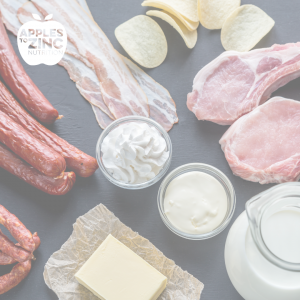
Saturated fat is particularly high in foods such as:
butter, ghee, cream, fatty and processed meats, pastries, cakes and biscuits, as well as coconut and palm oil.
That doesn’t mean you can never eat them.
I certainly don’t expect my clients to stop eating cheese or enjoying a slice of cake.
What matters is the overall balance.
If butter, cheese, processed meat, pastries and chocolate feature heavily every day, I’d probably want to look at that.
If you have some cheese with lunch but cook predominantly with olive oil, regularly eat oily fish, include nuts and seeds and eat plenty of plants, that’s a very different dietary pattern.
Context matters!
Butter V Margarine
This is one area where I think we need more nuance than simply declaring:
“Margarine is healthier than butter.” or vice versa!
Butter is relatively minimally processed, but it’s also high in saturated fat.
Modern vegetable-oil spreads are generally lower in saturated fat and higher in unsaturated fat than butter. The industrial trans fats historically associated with some margarines have also largely been removed from the UK food supply.
From a cholesterol and cardiovascular health perspective, replacing some saturated fat with unsaturated fat is supported by the evidence.
However, many commercial spreads are manufactured from oils that have undergone extraction and refining before being processed with other ingredients to create the finished spread.
Personally, I don’t think this needs to become a choice between:
butter OR margarine.
There’s a third option.
I’d rather see most of someone’s added fats coming from foods such as extra-virgin olive oil, nuts, seeds, avocado and oily fish, with smaller amounts of butter if they enjoy it.
If someone has raised LDL cholesterol or increased cardiovascular risk, reducing butter and other major sources of saturated fat becomes more important, and an unsaturated oil-based spread may be a useful swap.
That’s why nutrition advice needs context.
It’s about looking at the individual and the whole diet, rather than declaring one food universally “healthy” and another “unhealthy”.
Is Coconut Oil A Healthy Fat?
Coconut oil is another great example of how confusing nutrition messages can become.
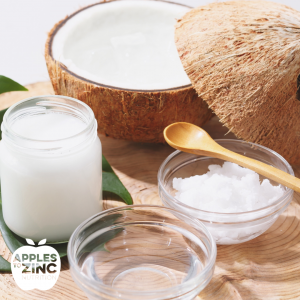
It has been promoted as a “healthy fat”, partly because it contains fats called medium-chain triglycerides (MCTs), which the body can use relatively quickly for energy. However, much of the research showing benefits from MCTs has used concentrated MCT oil, rather than the coconut oil you'd buy in the supermarket.
 If you're interested in why coconut oil gained its healthy reputation, this [Harvard Nutrition Source guide to coconut oil] gives a useful, balanced explanation.
Coconut oil is also very high in saturated fat and can raise LDL cholesterol compared with unsaturated oils such as olive oil.
So I wouldn't describe coconut oil as either a “superfood” or something you need to avoid.
If you enjoy the flavour, using a little in a curry or particular recipe is absolutely fine. But I wouldn't replace your everyday olive or rapeseed oil with coconut oil because you've heard it's healthier.
For regular use, olive or rapeseed oil would still generally be my preference.
Do Healthy Fats Make You Gain Weight?
Eating fat doesn’t automatically make you fat.
Weight gain occurs when, over time, we consistently consume more energy than our bodies use – and excess energy can come from fat, carbohydrate or protein.
But because fat is particularly energy dense, portion awareness still matters.
A small handful of nuts? Great.
Eating half a large bag while watching television because they’re “healthy”? Quite different.
A measured drizzle of olive oil over your vegetables? Great.
Three tablespoons poured freely into the pan without noticing? Again, quite different.
This is something I sometimes see with women who genuinely have a very nutritious diet but are confused about why their weight isn’t changing.
Healthy foods still contain energy. That doesn’t make them unhealthy – it simply means quantity still matters.
What about Trans Fats?
Trans fats used to deserve much more attention than they do now in the UK.
Industrially produced trans fats can adversely affect cholesterol and cardiovascular health, but most UK manufacturers and supermarkets have removed partially hydrogenated oils from their products and average intakes are now relatively low.
So while they’re certainly not something we need to seek out, saturated fat is a much more relevant consideration for most women in the UK today.
If you’re checking an imported or highly processed food, you can still look for “partially hydrogenated oil” on the ingredients list.
Healthy Fats For Women: What Does It Actually Look Like?
This is the part I think nutrition advice sometimes forgets.
Knowing the difference between monounsaturated, polyunsaturated and saturated fatty acids is lovely.......But you’ve still got to make dinner tonight!
You don’t need to calculate percentages, achieve a perfect omega ratio or analyse every gram of fat you eat.
Instead, focus on a few simple principles.
- Make olive or rapeseed oil your main cooking oils, but measure rather than free-pour them.
- Choose extra-virgin or cold-pressed olive oil where you can.
- Include a small portion of nuts or seeds regularly (e.g once a day).
- Eat oily fish each week.
- Enjoy avocado or a good-quality nut butter.
- And keep butter, cream, coconut oil, fatty meats and highly processed foods as smaller or less frequent parts of your overall diet rather than foods you automatically need to ban.
Most importantly, look at the whole meal and the whole week, rather than obsessing about one ingredient.
That's how we make nutrition work in the real world.
The Bottom Line: Don't Be Afraid Of Healthy Fats
If you’ve spent years choosing everything low-fat, you don’t need to be frightened of adding olive oil to your salad or eating a handful of nuts.
Equally, something doesn’t become an unlimited food simply because Instagram has labelled it a “healthy fat”.
We need dietary fat. We just need to be smart about the type and the amount.
For women, particularly as we move through our 40s, 50s and beyond, prioritising healthy unsaturated fats while keeping an eye on saturated fat is one practical way we can support cardiovascular and metabolic health.
But it’s only one piece of the puzzle.
Your protein, fibre, vegetables, overall energy intake, movement, sleep and stress all matter too.
And that’s really what making sense of nutrition is about.
Not another list of foods you’re allowed and not allowed to eat.
It’s understanding what matters, ignoring what doesn’t, and finding a way to put the evidence into practice in your life.
If This Resonates With You

If you've finished this article realising that fats are a little more complicated than simply "good" or "bad", you're definitely not alone.
Many of the women I work with feel confused by nutrition. One week they're being told to avoid fat, the next they're told to eat more of it. Butter is bad, then it's good again. Coconut oil is a superfood, then suddenly it isn't.
It's hardly surprising that knowing what to eat can sometimes feel harder than it should.
In reality, good nutrition isn't about following every new rule or trying to eat perfectly. It's about understanding what your body needs, what matters for your health and how to make that work in real life.
If you'd like to make sense of your nutrition and explore how a more personalised approach could support your health, you're very welcome to book a free, no-obligation discovery call.
We'll have a relaxed conversation about what's been going on, what you'd like to achieve and whether working together feels like the right fit.
You can book a free, no-obligation discovery call BOOK HERE NOW
Janet 
Citations/Further Reading
Click on the titles to head to the articles
NHS. Facts about fat.
NHS. How to eat less saturated fat.
NHS. Fish and shellfish.
British Heart Foundation. Fats explained.
British Heart Foundation. Margarine vs butter: which is healthier?
British Heart Foundation. Is coconut oil good for you?
Harvard T.H. Chan School of Public Health. Types of Fat.
Harvard T.H. Chan School of Public Health. Omega-3 Fatty Acids: An Essential Contribution.
About Janet
 Janet Padfield DipION is a Registered Nutritional Therapist and founder of Apples to Zinc Nutrition. She has been practising since 2014 and is registered with both BANT and the CNHC, with additional training in oncology nutrition and eating disorders.
Based in Maidenhead, Berkshire, Janet works predominantly with women, providing practical, evidence-based nutrition support that takes into account both health needs and the realities of everyday life. She works with clients both in person and online and also delivers nutrition talks and workshops for businesses.