Why Do You Want to Lose Weight? The Question Worth Asking First
Why Do You Want to Lose Weight? The Question Worth Asking First
Most of the women I speak to in clinic mention their weight at some point.
For some, weight loss is an important part of improving their health. For others, it's those last few kilos they'd quite like to lose. And sometimes weight isn't the reason they've come to see me at all – but somehow it still finds its way into the conversation.
What interests me isn't simply whether someone wants to lose weight.
I want to understand why.
Not because wanting to be slimmer is wrong.
You might want your clothes to fit differently. You might feel more comfortable at a slightly lower weight. You might have health reasons for reducing your weight. Or perhaps you've noticed that your current eating habits aren't making you feel particularly good and your weight is one sign of that.
All of those can be perfectly valid reasons.
But sometimes, when we start digging a little deeper, something else emerges:
"I feel like I should be thinner."
And should is where things get interesting.
Why Do I Want To Lose Weight?
When I ask women this question, I tend to hear variations of the same answers:
- "I'd feel better about myself."
- "I used to be thinner and I'd like to get back there."
- "This is the heaviest I've been and I feel like I need to do something about it."
Again, none of these feelings are wrong.
But I think they're worth exploring.
Because somewhere along the line, many of us have absorbed the idea that being thinner won't simply change our body – it will change how we feel about ourselves.
And that's a lot to expect from a number on the scales.
When Did The Bathroom Scales Become A Measure Of Happiness?
I've spoken to women who've woken up feeling perfectly good about themselves, stepped onto the scales and suddenly felt disappointed, guilty or frustrated for the rest of the day.
Nothing about their body changed during those few seconds.
Only the number they saw.
That's an extraordinary amount of power to give a set of scales.
Body weight can be useful information. In some circumstances it can help us monitor changes in health or progress towards an appropriate weight-related goal.
But it doesn't measure your health in its entirety.
And it certainly doesn't measure your worth.
When Did We Learn That Thinner Means Happier?
This is the bit we can't ignore.
Women haven't randomly decided that thinner is better.
For decades we've been surrounded by messages about what an acceptable female body is supposed to look like.
Magazines scrutinised celebrities for gaining weight, losing weight, having cellulite, wearing the "wrong" outfit or being photographed from an unflattering angle.
And while magazines may have become less influential, social media has arguably taken their place.
Now we're exposed to bodies all day.
Bodies that may have been carefully posed, filtered, edited, lit from the perfect angle or selected from 50 other photographs that didn't make the cut.
Even celebrities whose bodies fall well within a healthy range can find themselves subjected to headlines and comments about weight gain.
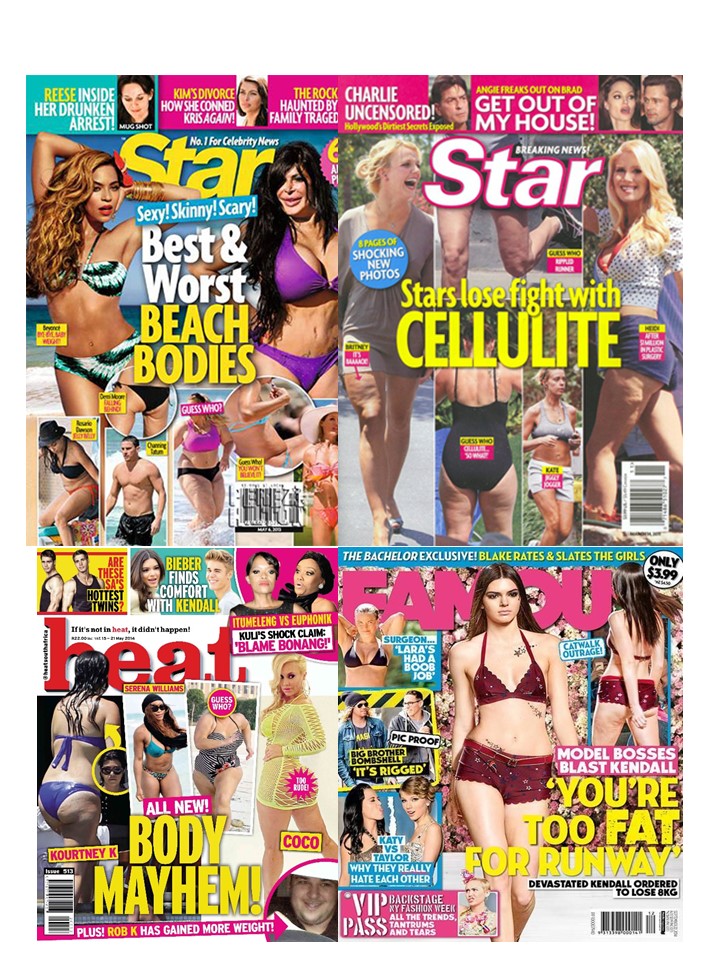
When we see messages like these repeatedly, it's hardly surprising that they influence how we judge our own bodies.
If she's apparently too big, what does that say about me?
And if every transformation story shows a miserable "before" picture followed by a smiling, confident, slimmer "after", it's very easy to absorb another message:
Thin = happy.
Except real life isn't that simple.
There are happy people in larger bodies.
There are deeply unhappy people in smaller bodies.
And there are an awful lot of perfectly normal women with wobbly bits living very good lives.
Wanting To Lose Weight Isn't "Wrong"
I think this is important to say.
Challenging society's obsession with women's weight doesn't mean pretending body weight is completely irrelevant.
Excess body fat can affect health, and there are circumstances where losing weight may reduce health risks.
But health isn't the only acceptable reason for wanting to change your body either.
You are allowed to think:
"I'd prefer to be a little slimmer."
What matters is whether you genuinely want that – rather than feeling that your body isn't acceptable because you've spent decades being told what women are supposed to look like.
And I'd also want to know what pursuing that goal involves.
Because there's a big difference between gradually changing some eating habits while continuing to enjoy your life and spending years trapped in restriction, guilt and starting again.
When Weight Loss Becomes A Cycle
This is where things can become difficult.
You're unhappy with your weight, so you decide something has to change.
Monday arrives.
You become really strict.
You cut out certain foods. Portions get smaller. You're "being good".
You may initially lose some weight.
But eventually normal life happens.
You're hungry. You're stressed. You go out for dinner. You have a holiday. Someone brings cake into work. Or you're simply fed up with thinking about food all the time.
You eat something you weren't "supposed" to eat.
And suddenly you feel you've failed.
So you might as well have something else.
Then comes the guilt.
And the promise that you'll start again tomorrow.
Restriction → overeating → guilt → restriction.
Not everyone who diets develops disordered eating, of course. But repeated dieting, compensatory behaviours and rigid food rules can contribute to a more difficult relationship with food for some people.
That's why I'm increasingly interested not simply in what someone is eating, but in the thoughts, rules and beliefs sitting underneath it.
A Conversation That Completely Changed The Goal
I remember having a long conversation with a friend who wanted to lose weight.
She'd spent years trying different diets with varying degrees of success and felt frustrated that she could never seem to stick to healthy eating consistently.
So we stopped talking about food for a moment.
Instead, we talked about why she wanted to lose weight.
- What would actually change?
- How would her life be different?
- What would she be able to do that she couldn't do now?
- How would she feel?
The conversation was really revealing and she was actually pretty happy.
She had a family who loved her exactly as she was. She was doing the things she wanted to do. There wasn't a particular activity she was avoiding because of her weight.
And when we really explored it, the main tangible outcome of losing the weight was...
she'd wear a smaller clothes size.
That didn't mean she wasn't allowed to want that. But it helped her recognise that losing a significant amount of weight simply wasn't important enough to her to justify the amount of restriction and mental effort she'd repeatedly been putting herself through.
So the goal changed.
Rather than constantly trying to lose weight, she started focusing on some healthier habits that helped her feel better and gave her more energy.
Interestingly, weight might change as a consequence of those habits.
But it was no longer the thing determining whether she'd succeeded.
And that made the changes feel very different.
Before Trying To Lose Weight Ask Yourself This
If you're thinking about losing weight, I'd encourage you to spend a little time understanding what you're actually hoping to achieve.
Ask yourself:
- Why do I want to lose weight?
- Where did my idea of what I "should" weigh come from?
- What do I believe will be different if I lose it?
- Could any of those things improve without my weight changing?
- How would I need to eat or live to maintain my target weight?
- Would I be happy living that way long term?
- Is this goal mainly about my health, my appearance, how I feel – or other people's expectations?
- If the scales didn't change but my energy, strength, health and relationship with food improved, how would I feel about that?
There isn't a correct answer.
You might go through all of those questions and conclude:
"Yes. I still want to lose some weight."
That's okay....But now you're making that decision with a much clearer understanding of what you're actually trying to achieve.
Your Weight Can Be a Goal Without Becoming THE Goal
There's nothing inherently wrong with wanting to lose weight.
Equally, you don't have to pursue weight loss simply because your body has changed, you've reached a particular clothes size or Instagram has convinced you that everybody else has a flatter stomach.
What matters is understanding why the goal matters to you and what pursuing it is costing you.
If reaching a particular number requires constant hunger, avoiding social occasions, obsessing about food or repeatedly feeling as though you've failed, I think it's worth questioning whether that number deserves quite so much importance.
Your goal might still be weight loss.
Or it might become feeling stronger, improving your cholesterol, having more energy, eating more consistently, reducing cravings or simply feeling more comfortable and confident around food.
And sometimes, improving those things may result in some weight loss anyway.
The point isn't that weight doesn't matter at all. It's that it doesn't (and shouldn't) have to be the only thing that matters.
Making Nutrition Work for You
This is one of the reasons my work with women goes beyond simply telling them what to eat.
Yes, nutrition matters enormously.
But knowing that vegetables are good for you or that eating enough protein is important isn't always the difficult bit.
Sometimes we need to understand the beliefs, expectations and habits influencing the choices you're making too.
 We look at what you're eating, what your body needs, what's getting in the way and – importantly – what you're actually trying to achieve.
Because making nutrition work isn't about forcing yourself to follow another diet.
It's about finding an approach that supports your health and fits your real life.
If you've recognised yourself while reading this article and you'd like to explore your nutrition, health or relationship with food in more detail, you're very welcome to book a free, no-obligation call.
We'll have a relaxed conversation about what's been going on, what you'd like to achieve and whether working together feels like the right fit.
Janet x.
A note about eating disorders and disordered eating
This article is intended as general information and isn't a substitute for individual medical advice. If thoughts about your weight, body image or food are causing you distress, or you're worried that your eating behaviours may be becoming restrictive, compulsive or difficult to control, please speak to your GP or an appropriately qualified healthcare professional. You can also find specialist information and support through Beat, the UK's eating disorder charity.